
OSM Industry Intel • Spring 2026
L-Theanine Has Been Sold as a 30-Minute Ingredient. New Research Says It Is Also Doing Something Much Slower.
A new study traces L-theanine’s effects on mood through an unexpected route: the gut microbiome. It reshaped bacterial populations, boosted short-chain fatty acid production, and calmed the same inflammatory pathway in both the intestine and the brain. The dose it took to do that is the part brands need to see.
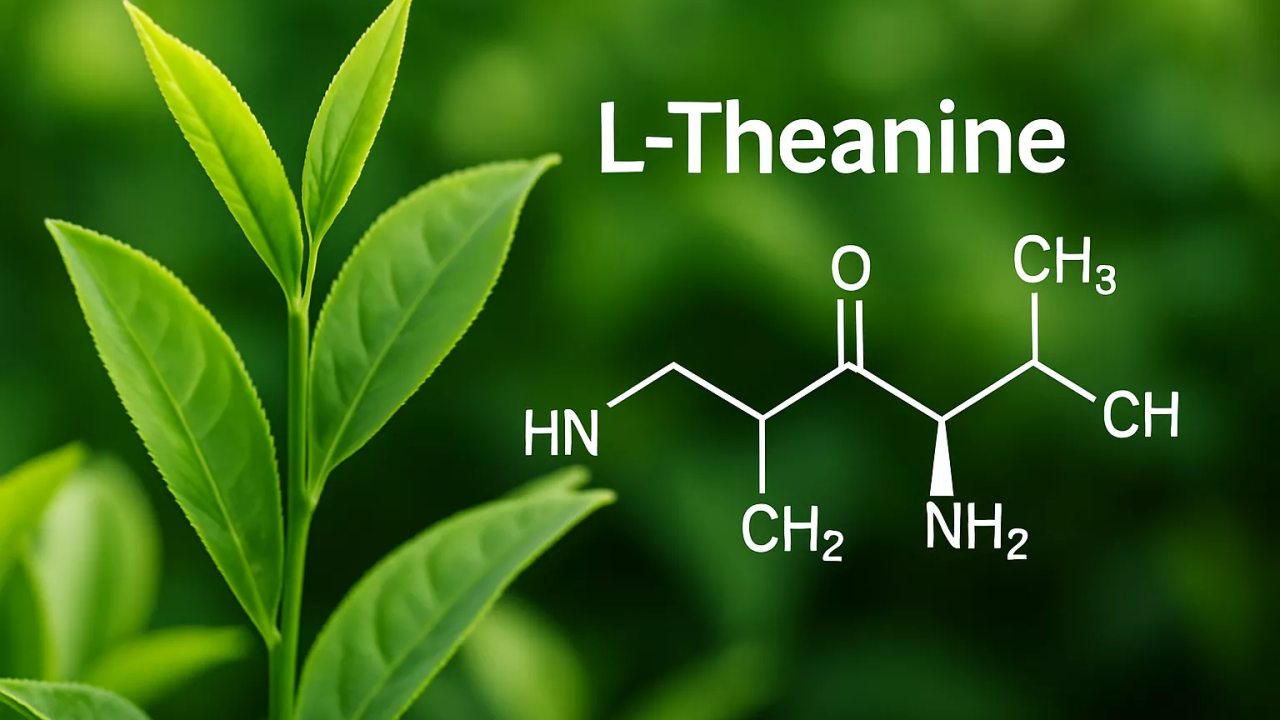
L-theanine has one of the tidiest stories in the entire supplement category. It is the amino acid from green tea that gives you calm without the couch-lock, it takes the edge off caffeine, it works in about thirty minutes, and it has been marketed almost exclusively on that acute experience for as long as anyone has been selling it. Take it, feel focused and unhurried, done.
That story is not wrong. It is just apparently incomplete in an interesting way.
A study published in npj Science of Food went looking for how L-theanine actually improves mood over the long haul, and the answer it landed on was not really about neurotransmitters at all. It was about the gut. Specifically, L-theanine reshaped the gut microbiota, drove up production of short-chain fatty acids, and through that route quieted an inflammatory signaling pathway in both the intestinal lining and the prefrontal cortex simultaneously.
That is a meaningfully different product than “calm in thirty minutes.” It reframes L-theanine from a fast-acting mood modulator into something closer to a gut-brain axis ingredient, which is a category with far more depth and far better shelf-story potential.
There is also a number buried in this paper that most brands are going to skip right past, and it is arguably the most important thing in the whole study for anyone actually manufacturing product. We will get to it.
Here is what the research found, the dose reality nobody is talking about, and where the honest product opportunity sits for 2026.
What the Study Actually Found
First, the setup, because it matters for how much weight to put on this. Researchers used a chronic unpredictable mild stress model in mice, which is the standard preclinical approach for producing depression-like behavior. Over six weeks, mice were exposed to randomized stressors while receiving L-theanine at three dose levels. Behavior was measured with the usual battery: open field test, sucrose preference, forced swim, tail suspension. The stressed control mice developed the expected profile of reduced exploration, anhedonia, and behavioral despair. The two higher L-theanine doses substantially reversed it.
That much is not new. L-theanine has shown antidepressant-like activity in animal models before. What is new is the mechanism the researchers traced, and it starts somewhere most people would not look.
Step One: The Microbiome Gets Rebuilt
Sequencing of the gut microbiota showed that chronic stress meaningfully shifted bacterial populations, enriching several genera associated with inflammation and gut dysfunction. L-theanine reversed that shift and went further, enriching a specific set of beneficial genera: Lactobacillus, Roseburia, Lachnospiraceae, Alistipes, Lachnoclostridium, and Marvinbryantia.
That list is not random. Those genera share a common job. They ferment fiber into short-chain fatty acids.
Step Two: SCFA Production Climbs
Short-chain fatty acids (acetate, propionate, butyrate, and a few others) are the metabolites gut bacteria produce from fiber, and they are one of the primary chemical languages the gut uses to talk to the rest of the body. Chronic stress knocked SCFA levels down across the board. L-theanine at the higher doses brought them back, and in some cases dramatically. Butyric acid in the gut rose 106% over the stressed group. Acetic acid in serum rose 469%.
Crucially, the researchers also looked at the receptors that read those signals. SCFAs act through G-protein coupled receptors, mainly GPR41 and GPR43. Stress suppressed the expression of both, in the colon and in the prefrontal cortex. So the stressed animals had less signal and less ability to hear it. L-theanine restored receptor expression in both tissues, close to healthy control levels. That is a more complete rescue than just raising the metabolite.
Step Three: The Same Inflammatory Switch, Turned Down in Two Places
Here is the part that makes the story hang together. The researchers tracked a specific inflammatory cascade, TLR9 to NLRP3 to Caspase-1, which is a well-characterized route to inflammasome activation and IL-1β release. Chronic stress lit that pathway up in the colon. It also lit it up in the prefrontal cortex. L-theanine turned it down in both.
And the barrier story mirrors it exactly. Two tight-junction proteins, ZO-1 and occludin, hold the intestinal lining together. The same two proteins are central to the blood-brain barrier. Stress depleted them in the gut and in the brain. L-theanine restored them in the gut and in the brain.
Same pathway, same proteins, two organs, one intervention. Whether or not every step of that chain holds up under further study, it is an unusually coherent mechanistic picture, and it is the kind of thing that makes a good education story because a consumer can actually follow it: fix the gut, produce more of the good metabolites, calm the inflammation, protect the barrier, and the brain benefits downstream.
Neurotransmitters did recover too. Serum serotonin, dopamine, and GABA all came back up with treatment. But in this study’s framing, that looks more like a downstream consequence of the gut work than the primary event.
THE FORMULATOR’S TAKE
Now the number. The effective dose in this study was 800 mg per kilogram of mouse body weight, with a partial effect at 400. The paper does the interspecies conversion for you and puts the human equivalent at roughly 88 mg per kilogram of body weight per day. For a 70 kg adult, that is about six grams of L-theanine daily. Typical supplement doses run 100 to 200 mg. So the gut-brain mechanism described here was demonstrated at something on the order of thirty times a standard serving. That does not invalidate anything. L-theanine is GRAS, it has a clean safety record, and human doses in the 200 to 400 mg range have real evidence behind them for acute calm and focus. But if you are planning to put “supports the gut-brain axis” on a 100 mg theanine gummy on the strength of this paper, you are making a claim the underlying study does not support at your dose. Know that before your competitors find out for you.
The Caveats Worth Knowing
Beyond the dose gap, a few things deserve a straight airing. This is a mouse study, not a human trial, and the chronic unpredictable mild stress model approximates human depression but is not the same thing. Group sizes were small, five to six animals per arm, which the authors acknowledge. The mechanistic chain is well-constructed but largely correlational at several links: the study shows L-theanine changed the microbiome and shows SCFAs rose and shows inflammation fell, but it did not run the germ-free or fecal-transplant experiments that would prove the microbiome shift is what caused the brain effect rather than accompanying it.
None of that makes the work uninteresting. It is a genuinely well-executed study with a coherent mechanism and a real result. It just means the honest framing is “a promising mechanism demonstrated preclinically at high doses,” not “clinically proven gut-brain therapy.”
Where This Fits in the 2026 Product Roadmap
Strip away the hype and there is still a real strategic opening here. L-theanine is currently trapped in a commodity position. It is a cheap, familiar, well-tolerated ingredient that shows up as a supporting player in a thousand nootropic and sleep stacks, competing almost entirely on price and on a benefit claim every competitor makes identically. The gut-brain research offers a way out of that, provided a brand is willing to formulate honestly rather than just rewrite the label.
Here is where the opportunity is for brands working with a contract manufacturer.
Play 1: Build the Synbiotic, Do Not Just Raise the Theanine
The tempting response to this study is to dose theanine higher. That is expensive, and it misses the more interesting read. The mechanism the paper describes runs through SCFA-producing bacteria, which means the rate-limiting factor is not just theanine, it is whether the consumer has the bacteria and the fermentable substrate to produce SCFAs in the first place.
A far smarter formulation pairs a meaningful theanine dose with the organisms and the fuel: Lactobacillus strains, a prebiotic fiber that those genera actually ferment, and optionally a direct butyrate source. That is a product built on the mechanism rather than borrowing its headline. It is also genuinely differentiated, because almost nobody in the calm-and-focus aisle is formulating this way.
Play 2: The AM/PM Gut-Brain System
The dual-timeline nature of this ingredient is a gift for product architecture. L-theanine has a fast, felt effect and, per this research, a slow structural one. That maps naturally onto a two-part daily system: a morning formula built around theanine’s acute calm-focus profile paired with caffeine or without it, and an evening formula weighted toward the microbiome side with the synbiotic components and sleep-supporting ingredients.
AM/PM systems carry higher perceived value, they build a daily ritual that improves subscription retention, and in this case the split is scientifically honest rather than arbitrary. You are selling the fast benefit in the morning and the slow benefit at night, and both are real.
Play 3: Stress Resilience for the Chronically Frazzled
The study’s model was chronic stress, not acute stress, and that distinction is a positioning opportunity. Most calm products sell an in-the-moment fix. A product positioned around building resilience to ongoing stress over weeks speaks to a different and arguably larger consumer, the one whose baseline has been elevated for months and who has stopped believing a single capsule will fix it. Pair theanine with adaptogens and the synbiotic base and you have a coherent chronic-stress-support story with a mechanism behind it.
Play 4: The Barrier and Inflammation Platform
The tight-junction and inflammasome findings connect this ingredient to the broader cellular-health conversation happening across the longevity category right now. Gut barrier integrity, inflammatory signaling, and neuroinflammation are all active areas where consumer awareness is climbing fast. A brand can build an interconnected education platform linking gut health, brain health, and healthy aging, which is exactly the kind of catalog logic that increases average order value. The flavonoid and NAD+ angle we covered in our piece on apigenin and cellular NAD+ sits naturally alongside it, as does the brain-aging research in our microdose lithium orotate breakdown.
Play 5: Format Decisions Follow the Dose
This is where the dose math becomes a practical manufacturing constraint rather than a footnote. If your formulation calls for a meaningful theanine dose alongside probiotic organisms, prebiotic fiber, and additional actives, you have a volume problem that rules some formats out immediately. Gummies get difficult fast once fiber and live cultures enter the picture, and the technical challenges there are real, which we covered in our breakdown of the four key imperatives for gummy manufacturers in 2026. Stick packs and powders handle the volume comfortably and suit the daily-ritual positioning. Capsules work if you keep the formula tight. The right answer depends on your dose targets and your target demographic’s compliance habits, and it is worth settling before the formula is locked, not after. The muscle and whole-body energy angle in our piece on muscle as an endocrine organ is another place where format and dose drive the whole product decision.
Claims and Compliance Reality Check
This one has a bright line running through it and it is worth naming plainly. The study is a depression model. Depression is a disease. Any marketing that positions your product as treating, preventing, or alleviating depression is a drug claim, full stop, regardless of how the research is worded. The same goes for anxiety as a diagnosed condition.
The defensible lane is still wide. You can say a product supports a healthy stress response, supports mood, supports relaxation and focus, supports gut health, and supports the gut-brain axis, all as structure-function claims. What you cannot do is claim it suppresses inflammasomes, restores blood-brain barrier integrity, or modulates the TLR9 pathway, because those are mechanistic disease-adjacent claims describing findings from mice at doses your product almost certainly does not contain. Keep the mechanism in your education content where it belongs and where it will actually do more marketing work anyway. AI-driven monitoring is surfacing unsupported claims faster every quarter, which we got into in our analysis of how AI is changing supplement discovery.
The Bottom Line
L-theanine has been sold on a single, narrow, thirty-minute benefit for decades, and this research suggests there is a second and much slower story running underneath it through the gut microbiome and short-chain fatty acid production. That is a legitimate route out of commodity positioning for an ingredient that badly needs one. The catch is the dose, which in this study sat far above what any normal supplement delivers, and the honest response to that is to formulate around the mechanism with synbiotic support rather than to simply borrow the headline for an existing SKU. Brands that do the real formulation work here will have something defensible and genuinely differentiated. Brands that just add “gut-brain axis” to their current label will have a claim problem waiting for them.
Ready to Build?
Build a gut-brain formula that holds up to scrutiny, with a USDA Organic and GMP-certified manufacturer.
Organic Supplement Manufacturing handles formulation, sourcing, manufacturing, and fulfillment for stick packs, powders, capsules, gummies, and AM/PM systems, including synbiotic formulations. Low MOQs, full-service support, and a team that reads the primary literature before the label gets printed.
Start a Conversation →Source: Peng Y, Yu T, Qin C, Li F, Xu Z, Fang Q, Cheng A, Zhai X, Fu X, Li D, Hu S. l-theanine-targeted prefrontal cortex improves CUMS-induced depression via the gut-short-chain fatty acids-brain axis. npj Science of Food. 2025; 10:4. doi:10.1038/s41538-025-00651-0. Read the study.
Disclaimer: This article is intended for supplement brand and contract manufacturing audiences for informational and educational purposes only. It is not intended as medical advice. The research discussed was conducted in a preclinical mouse model at doses substantially higher than typical human supplement servings, and has not been replicated in human clinical trials. Statements regarding dietary supplements have not been evaluated by the FDA and are not intended to diagnose, treat, cure, or prevent any disease.