
OSM Industry Intel • 2026
The Apigenin Story Just Got More Interesting: A Common Flavonoid That Raises Cellular NAD+
A peer-reviewed study shows the plant flavonoid apigenin inhibits CD38, the enzyme that quietly burns through your NAD+ supply. For brands building longevity and metabolic SKUs, this is a mechanism worth understanding.
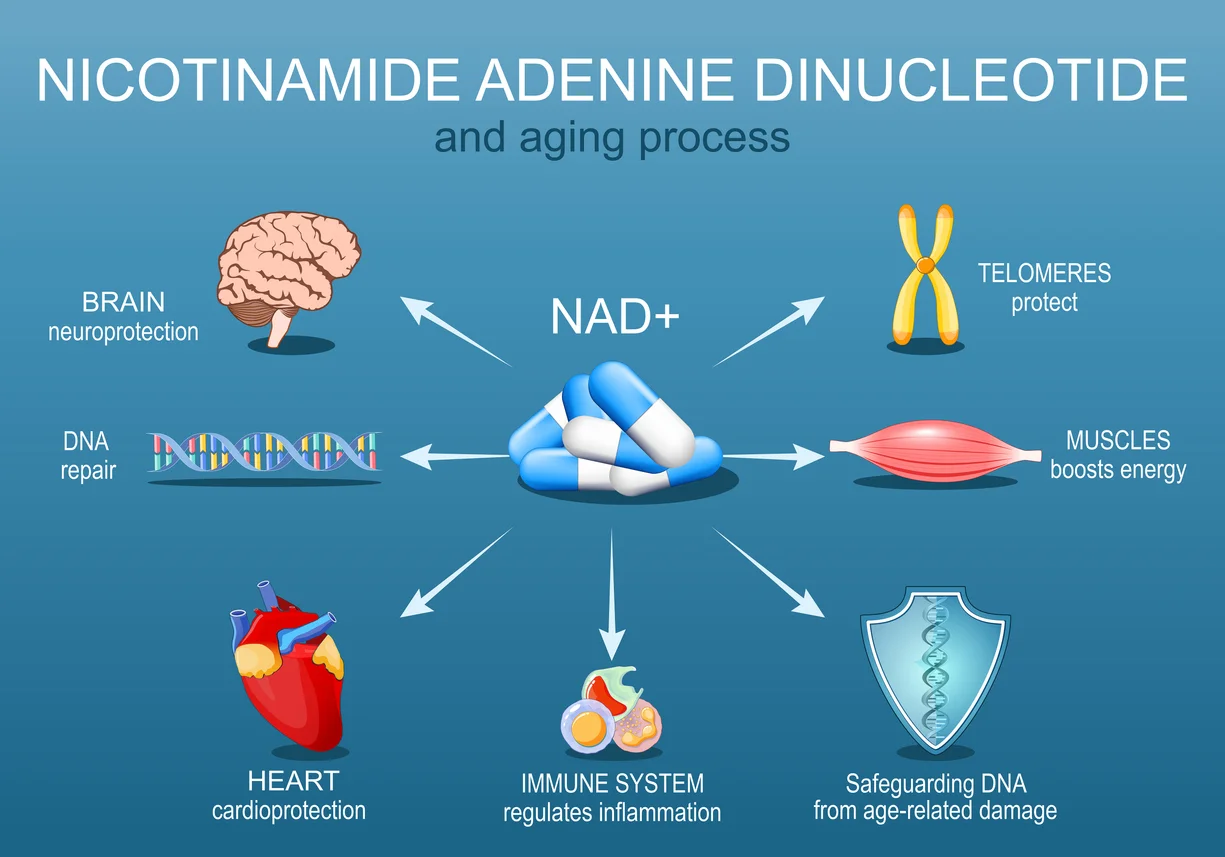
NAD+ has been having a moment for a few years now. Every longevity brand wants a piece of it, and the shelves are full of NR, NMN, and niacin products all promising to top up the same molecule. Most of that conversation is about putting more NAD+ precursors into the body. Almost nobody is talking about the other side of the equation: how fast your body is spending the NAD+ it already has.
That is where this gets interesting.
A study published in the journal Diabetes identified the plant flavonoid apigenin as an inhibitor of CD38, an enzyme the authors describe as the primary consumer of NAD+ in mammalian tissue. In plain terms, CD38 is one of the biggest drains on your NAD+ supply. Slow it down, and NAD+ levels climb without adding a single milligram of precursor. The researchers showed this in cells and then in obese mice, where apigenin raised liver NAD+, lowered protein acetylation, and improved glucose handling and fat metabolism.
Apigenin is not exotic. It is the same flavonoid found in chamomile, parsley, and celery. That combination of household familiarity and a clean, specific mechanism is exactly the kind of thing that makes a formulator pay attention.
What the Study Actually Found
The researchers started by establishing what CD38 does inside a cell. When they forced cells to make extra CD38, NAD+ levels dropped and overall protein acetylation went up. When they knocked CD38 down, the opposite happened: NAD+ rose and acetylation fell. That matters because a family of enzymes called sirtuins, including the well-studied SIRT1, depend on NAD+ to do their job. More NAD+ means more sirtuin activity, and sirtuins are the proteins doing a lot of the heavy lifting people associate with metabolic health and healthy aging.
Apigenin hits CD38 directly
Using purified human CD38, the team showed apigenin inhibited the enzyme with an IC50 around 10 micromolar, meaning it took only a modest concentration to cut the enzyme’s activity in half. Quercetin, a flavonoid most people already recognize, did the same thing at a similar potency. Apigenin was the newer find here.
The cell work confirmed it was not just a test-tube curiosity. Apigenin raised NAD+ inside living cells in a dose-dependent way, and it protected NAD+ from being depleted over time. The clincher: in cells engineered to lack CD38 entirely, apigenin did nothing to NAD+ levels. That is the kind of clean control that tells you the effect is genuinely running through CD38 and not some unrelated pathway.
The animal data is where it gets practical
The researchers put mice on a high-fat diet for four weeks, then gave half of them apigenin for a week. The treated mice showed lower CD38 activity in the liver, higher liver NAD+, and a measurable drop in protein acetylation. More importantly for anyone thinking about metabolic positioning, the apigenin mice had lower blood glucose, better glucose tolerance, increased expression of fat-oxidation enzymes, and lower liver triglyceride content. When the researchers blocked SIRT1 specifically, the benefit disappeared, which ties the whole effect back to the NAD+ and sirtuin axis.
The Formulator’s Take
The strategically interesting part is the framing, not just the molecule. Nearly every NAD+ product on the market is a precursor play, telling the body to make more. CD38 inhibition is the conservation play, telling the body to waste less. A product that pairs a precursor with a CD38-modulating botanical like apigenin tells a more complete story than either piece alone. That is a positioning angle most brand teams have not touched yet.
The honest caveats
This is preclinical work. The functional outcomes happened in mice, not humans, and the mouse dose was delivered by injection rather than by mouth, which says nothing about how well oral apigenin absorbs in a person. Apigenin is also known for fairly modest oral bioavailability in its plain form, which is precisely the kind of problem that delivery technology exists to solve. If you are serious about an apigenin SKU, the absorption question is the first thing to solve, and it is worth reading our breakdown of liposomal technology and where it actually earns its keep before committing to a format. None of this makes the mechanism less real. It just means the science is a starting point for product development, not a finished disease claim.
Where Apigenin Fits in a 2026 Product Line
The category fit here is strong because apigenin sits at the intersection of three trends that are all growing at once: longevity and NAD+ support, metabolic health, and the broader move toward recognizable plant-based ingredients. Here are the formats worth considering.
1. NAD+ support capsules and the conservation angle
The most direct play is a longevity or cellular-health capsule that pairs an apigenin extract with an NAD+ precursor. The narrative writes itself: one ingredient helps build NAD+, the other helps protect it. This is a stacked, mechanism-driven story that resonates with the educated longevity buyer who is tired of single-ingredient hype.
2. Metabolic and weight-management formulas
The animal data around glucose tolerance and fat oxidation lines up neatly with the surging interest in metabolic support products. Apigenin can anchor or complement a metabolic-health SKU aimed at the consumer who is thinking about blood sugar balance and body composition as part of general wellness rather than as a medical intervention.
3. Calm and sleep formulas with a second story
Apigenin is already the active many people associate with chamomile’s calming reputation, which gives it a natural home in relaxation and sleep products. The new NAD+ angle lets a brand layer a cellular-health benefit onto a category that is usually sold purely on feel. That dual narrative is a differentiator on a crowded sleep shelf.
4. Gummies and functional formats
If you want apigenin in a format people actually enjoy taking daily, gummies are the obvious route, though bioavailability and matrix stability both need real attention with a flavonoid like this. The gummy category is changing fast on the manufacturing side, and the brands that win are the ones who understand those shifts early. Our take on what is reshaping gummy production in 2026 is worth a read before you spec a chewable apigenin SKU.
One more thing worth planning for: however good your formula is, it still has to get found. The way consumers discover supplements is shifting under everyone’s feet, and the brands building NAD+ and metabolic products right now should be thinking about that distribution reality from day one. We covered it in our piece on how AI is changing supplement discovery.
Thinking About an NAD+ or Metabolic SKU?
OSM helps supplement brands turn emerging science like this into shelf-ready products, from formulation and sourcing to delivery format and compliance-aware labeling. Let’s talk about where apigenin fits in your portfolio.
Start a ConversationSource: Escande C, Nin V, Price NL, et al. Flavonoid Apigenin Is an Inhibitor of the NAD+ase CD38: Implications for Cellular NAD+ Metabolism, Protein Acetylation, and Treatment of Metabolic Syndrome. Diabetes. 2013;62(4):1084-1093. Full text and supplementary data available via PubMed Central: PMC3609577 supplementary materials.
These statements have not been evaluated by the Food and Drug Administration. Products discussed are not intended to diagnose, treat, cure, or prevent any disease. This article is intended for supplement industry professionals and is educational in nature.