

OSM Industry Intel • Spring 2026
Brain Fog Might Be a Fuel Delivery Problem. Here Is the Metabolic Workaround Brands Should Watch.
A January 2026 review lays out how the aging or insulin-resistant brain slowly loses its ability to burn glucose, and how alternative fuels like ketones may sidestep the broken machinery entirely. Here is what it means for the cognitive and longevity supplement categories.
Here is a frame that changes how you think about brain fog, the midday mental crash, and even the early stages of cognitive decline. What if these are not really about “tired neurons” in a vague sense, but about a specific, mechanical failure: fuel that cannot get where it needs to go?
That is the picture a recent metabolic review paints, and it is a compelling one for the supplement industry.
The brain is an energy hog. It runs almost entirely on glucose, and it burns through a staggering amount of it. To get that glucose into neurons and turn it into usable energy, the brain relies on insulin signaling and a fleet of glucose transporters. The problem is that this system degrades. In aging, in type 2 diabetes, and in Alzheimer’s (which researchers increasingly and only half-jokingly call “type 3 diabetes”), brain cells develop localized insulin resistance. The glucose is right there in the bloodstream, but the neurons have lost the ability to pull it in and burn it efficiently. The cells are, in a real sense, starving in the middle of plenty.
The 2026 review in Frontiers in Nutrition lays out the mechanism in detail, and it points toward an elegant workaround: if the glucose door is jammed, give the brain a fuel that uses a different door. That is where ketones and certain lipids come in, and it is the seed of a genuinely interesting product category built around metabolic fuel for the brain.
As always with a story this good, there is a discipline required to tell it responsibly, because most of this evidence lives in the “promising and mechanistic” zone rather than the “clinically proven cure” zone. Let us walk through the real science and where a brand can credibly build.
Here is the mechanism, the honest caveats, and the product opportunity for 2026.
What the Review Actually Says
The review’s central concept is “metabolic reprogramming,” the idea that under stress or disease, neurons rewire their energy pathways. In the failing brain, that rewiring goes bad: glucose metabolism drops, mitochondria become less efficient, oxidative stress climbs, and the cell gets caught in a loop of energy shortage and inflammation. The review frames this as a “metabolism-inflammation axis” sitting at the heart of neurodegeneration.
Why Glucose Delivery Breaks Down
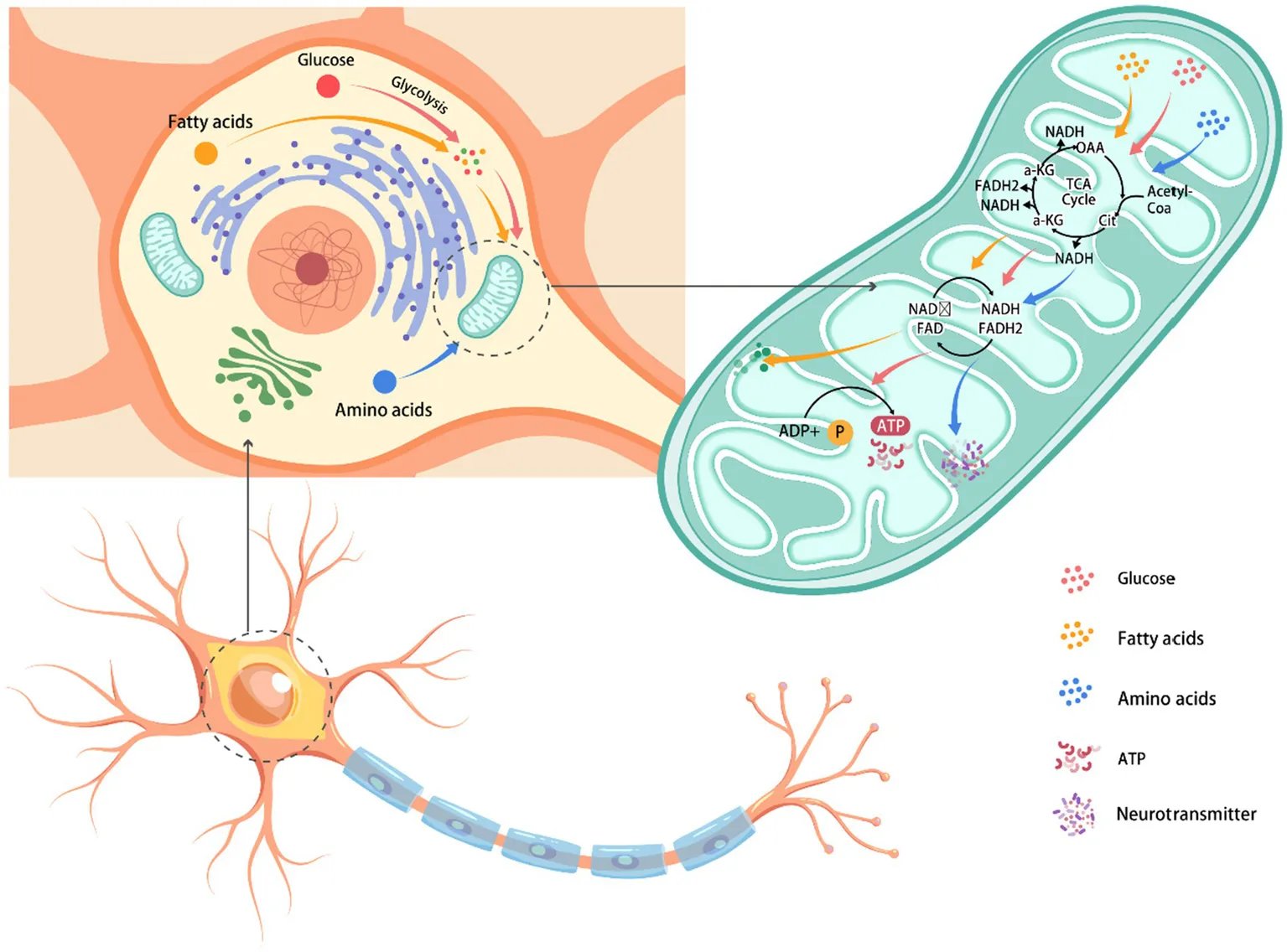
Neurons pull glucose in through transporters, run it through glycolysis to make pyruvate, and then feed that pyruvate into the mitochondria to run the TCA cycle and oxidative phosphorylation, which is where the real ATP gets made. Insulin helps regulate this whole chain. When insulin resistance sets in, glucose uptake drops and the critical insulin-driven survival pathways (PI3K/Akt and mTOR) get suppressed. The review notes that impaired glucose utilization and insulin resistance are hallmarks of Alzheimer’s, and that over 80% of Alzheimer’s patients also show type 2 diabetes or dysregulated blood sugar. The overlap is not a coincidence. It is a shared mechanism.
The Ketone Workaround
Here is the elegant part. Glucose is the brain’s default fuel, but it is not the only one. Ketone bodies, which the liver produces from fat when carbohydrates are scarce, are the brain’s backup fuel, and critically they do not depend on the same insulin-driven glucose transport that breaks down in insulin resistance. Ketones enter neurons through their own route and feed directly into mitochondrial energy production. The review highlights the ketogenic diet as an emerging intervention precisely because it forces the body to run on fat-derived ketones, providing an alternative energy source that enhances mitochondrial function and carries antioxidant and anti-inflammatory properties. In other words, when the glucose door is jammed, ketones walk in through a side entrance.
THE FORMULATOR’S TAKE
You do not need a full ketogenic diet to get ketones into the brain, and that is the commercial opening. Medium-chain triglycerides (MCTs), especially the C8 caprylic acid fraction, are rapidly converted by the liver into ketones even in someone eating a normal diet. That means a small, convenient dose of MCTs can raise circulating ketones and offer the brain an alternative fuel on demand, without asking the consumer to overhaul how they eat. That is the mechanistic basis for the entire “brain fuel” product category, and it is a far more consumer-friendly story than “go keto.” The product is not the diet. The product is the shortcut.
The Membrane Angle: DHA and Omega-3s
The review spends significant time on lipids, and this is the second pillar of the brain-fuel story. Omega-3 fatty acids, particularly DHA, are structural components of neuronal membranes. They keep the membrane fluid, which directly affects how well neurons transmit signals and maintain synaptic plasticity. DHA deficiency is linked to more neuroinflammation and faster decline, while DHA supplementation is associated with more stable membranes and neuroprotection. So the fuel story and the structure story are complementary: ketones and MCTs address the energy shortage, while omega-3s support the physical integrity of the cells doing the work.
The Supporting Cast
The review rounds out its list of metabolic-support interventions with several ingredients already familiar to the supplement world: coenzyme Q10 for mitochondrial electron transport, alpha-lipoic acid for glucose metabolism and antioxidant defense, nicotinamide riboside for raising NAD+ levels, B vitamins (B6, B12, folate) for neurotransmitter synthesis and homocysteine control, and the broader antioxidant and anti-inflammatory framework of the Mediterranean diet. None of these are magic bullets, but together they sketch a coherent “support brain energy metabolism” toolkit.
The Caveats Worth Knowing
This is a review, not a clinical trial, and the authors are refreshingly candid about the limits of the evidence. They explicitly note that many of the human studies are small (often fewer than 50 participants per group), that dosing and protocols vary wildly, that most of the strong data is in Alzheimer’s specifically rather than other conditions, and that long-term efficacy and safety data are thin. The review calls repeatedly for larger, better-controlled trials with real biomarker endpoints. For a supplement brand, the honest read is this: the mechanism (alternative fuels bypassing broken glucose metabolism) is well-established biochemistry, and ingredients like MCTs, DHA, and CoQ10 have legitimate cognitive-support and metabolic-support evidence. But “supports brain energy metabolism and mental clarity” is the defensible claim lane, not “reverses cognitive decline” or “treats Alzheimer’s.”

Where Brain Fuel Fits in the 2026 Product Roadmap
The strategic opportunity here is a rare one: a mechanism that speaks to two enormous markets at once. On one end, high-performing professionals who want cleaner mental energy without another triple espresso. On the other, the aging consumer worried about cognitive longevity. The “metabolic fuel for the brain” story bridges both, and it does it without leaning on stimulants, which is exactly where consumer demand is heading (the jittery-preworkout backlash is real, and “calm energy” is one of the strongest positioning trends in the category). Here is how the science translates into product.
Here is where the opportunity is for brands working with a contract manufacturer.
Format 1: The Neuro-Metabolic Fuel Stick
This is the flagship concept, and the format matters as much as the formula. A single-serve powder stick built around C8 MCT (the fastest ketone-producing fraction), designed to mix into coffee, water, or a smoothie, hits the on-demand “flip the switch” use case perfectly. Add complementary ingredients like a modest dose of DHA, some alpha-lipoic acid, and B vitamins, and you have a stimulant-free mental-clarity product with a genuine mechanistic story. The stick-pack format is portable, portioned, and premium-feeling, which is ideal for the busy-professional target. Position it as clean, non-jittery brain fuel for the midday crash.
Format 2: MCT-Forward Functional Creamers and Coffee Boosters
The coffee ritual is the perfect delivery vehicle for MCTs, and the “add it to your morning cup” behavior drives daily compliance almost automatically. A functional creamer or coffee booster built around MCT oil powder, with optional additions like collagen or adaptogens, taps into the massive functional-coffee trend while carrying the brain-fuel narrative. This is a high-repeat-purchase, ritual-anchored product category with real staying power.
Format 3: Cognitive Longevity Capsule Stacks
For the healthy-aging demographic, a daily capsule stack focused on the metabolic-support ingredients from the review (CoQ10, alpha-lipoic acid, DHA, B-complex, and potentially nicotinamide riboside for the NAD+ angle) makes a strong cognitive longevity product. This connects directly to the broader brain-aging conversation, including the lithium story we covered in our microdose lithium orotate breakdown and the NAD+ angle in our piece on apigenin and cellular NAD+. A brand can build a whole interconnected cognitive-longevity catalog around these overlapping mechanisms.
Format 4: The Metabolic-Cognitive Combo for the Diabetes-Adjacent Market
Given the review’s emphasis on the insulin-resistance-and-cognition overlap, there is a thoughtful (and carefully-worded) opportunity for a product aimed at the metabolically-conscious consumer: someone managing blood sugar who also cares about mental sharpness. Alpha-lipoic acid and MCTs both fit a “metabolic and cognitive support” narrative for this large and growing demographic. This requires an especially careful compliance hand, but the demographic overlap is real and underserved.
Format 5: The Whole-Body Energy Platform
Brain energy and muscle energy share a lot of the same mitochondrial machinery, which lets a brand connect a cognitive-fuel product to a broader physical-energy and healthy-aging catalog. The mitochondrial through-line ties naturally to the muscle-as-endocrine-organ story we explored in our piece on myokines and muscle. Format-wise, the brain-fuel concept works as sticks, powders, capsules, or functional gummies, and getting the format and the ingredient delivery right is its own technical challenge. For premium delivery of fat-soluble actives like DHA and CoQ10, our guide to liposomal supplement technology is a useful reference, and for gummy execution see our breakdown of the four key imperatives for gummy manufacturers in 2026.
Claims and Compliance Reality Check
The insulin-resistance-and-Alzheimer’s science is scientifically thrilling and legally radioactive, so this is the section to read twice. You can say a product “supports brain energy metabolism,” “supports mental clarity and focus,” “provides an alternative fuel source for the brain,” and “supports healthy cognitive function,” all within structure-function territory at appropriate doses. What you absolutely cannot do is claim it treats or prevents Alzheimer’s, reverses cognitive decline, treats insulin resistance or diabetes, or “cures” brain fog as a medical condition. The type-3-diabetes framing is a fantastic education hook for your content, but it is a disease reference and must stay out of your labeling. The same goes for the diabetes-adjacent product angle: keep it to metabolic and cognitive support, never disease management. AI-driven monitoring is surfacing claim violations faster than ever, which we covered in our analysis of how AI is changing supplement discovery. Build conservatively and keep the mechanism in the education layer.
The Bottom Line
The reframe at the heart of this research (that brain fog and cognitive decline are partly fuel-delivery failures) is both scientifically grounded and commercially powerful. It points toward a product category built on real biochemistry: alternative brain fuels like MCTs and ketones that bypass the broken glucose machinery, paired with structural and metabolic support from DHA, CoQ10, and B vitamins. The demand is there on both ends of the market, from stimulant-weary professionals to longevity-minded aging consumers. The winning brand is the one that tells the “flip the metabolic switch” story in its education content while keeping the label in defensible structure-function territory. Do that, and neuro-metabolic fuel is one of the most compelling product opportunities in the cognitive category for 2026.
Ready to Build?
Build a neuro-metabolic fuel line with a USDA Organic and GMP-certified manufacturer that keeps your claims defensible.
Organic Supplement Manufacturing handles formulation, sourcing, manufacturing, and fulfillment for stick packs, powders, functional creamers, capsules, and gummies. Low MOQs, full-service support, and a team that builds the claim architecture before the label gets printed.
Start a Conversation →Source: Fang L, Zhuang Y, Zhang M, Yang D, Zhang R, Peng J, Wang C. Dietary and metabolic reprogramming alleviates neurodegeneration: a review of mechanisms and clinical implications. Frontiers in Nutrition. 2026; 13:1706597. https://www.frontiersin.org/journals/nutrition/articles/10.3389/fnut.2026.1706597/full
Disclaimer: This article is intended for supplement brand and contract manufacturing audiences for informational and educational purposes only. It is not intended as medical advice. The source is a review of existing evidence, and the authors note that much of the underlying human data comes from small studies. Statements regarding dietary supplements have not been evaluated by the FDA and are not intended to diagnose, treat, cure, or prevent any disease.
Great content! Keep up the good work!