

OSM Industry Intel • Spring 2026
Science Just Found the Cellular “Toxic Waste Leak” Behind Inflammaging. Here Is the Supplement Angle.
A 2025 review pulls together a striking discovery: aging immune cells lose the ability to take out their own cellular trash, then leak mitochondrial DNA that the body mistakes for a viral invasion. The result is chronic, sterile, full-body inflammation. Here is what it means for longevity brands.
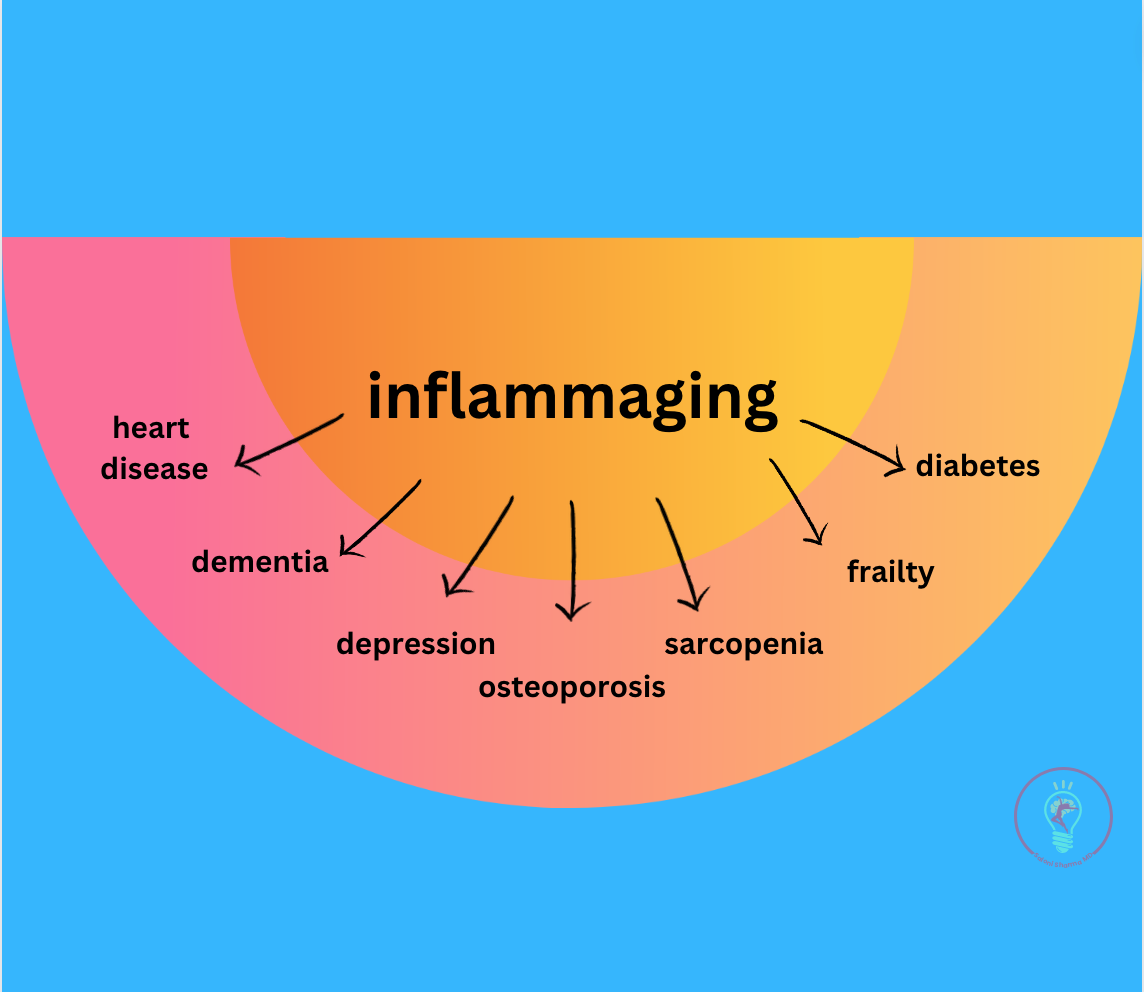
Everyone in the longevity space throws around the word “inflammaging.” Chronic, low-grade, full-body inflammation that creeps up with age and quietly drives a huge share of age-related disease. It is one of those terms that gets repeated so often it starts to feel like an explanation, when it is really just a description. The obvious question, the one that actually matters for product development, is why. Why do aging bodies start smoldering with inflammation that has no infection behind it?
A recent review pulled together a discovery that finally offers a satisfying, mechanistic answer, and it reads like a cellular crime scene.
Here is the short version. In aging immune cells, a protein called CISH ramps up. That protein degrades a key component of the cell’s proton pump, which is the machinery that keeps the lysosome (the cell’s recycling and waste-disposal center) properly acidic. Without that acidity, the lysosome can no longer break down damaged cellular components. Trash piles up. The cell forms bloated packets of undigested material that drift to the cell membrane and rupture, spilling raw mitochondrial DNA into the space outside the cell. And here is the kicker: your immune system cannot tell the difference between leaked mitochondrial DNA and viral DNA. It reads the spill as an infection and launches a full inflammatory response against a threat that was never there.
Multiply that across billions of aging cells and you get inflammaging. Not a vague “things wear down” story, but a specific, traceable failure of the cellular waste-disposal system that tricks the immune system into attacking the body’s own debris.
That is a genuinely compelling narrative for a longevity brand. But it comes with a big honesty requirement, because most of the interventions in this research are pharmaceutical, not nutritional. Let us walk through the real science and then map out where a supplement brand can credibly play.
Here is the mechanism, the caveats that matter, and the defensible product opportunity for 2026.
What the Research Actually Shows
The review is a broad survey of cellular senescence and immunosenescence, but the piece that makes the best product-education story is the CISH mechanism, published in Nature Aging. It is worth walking through carefully because the details are what make it credible.
The Lysosome Is the Cell’s Recycling Center
Every cell runs a waste-disposal operation. Damaged proteins, worn-out organelles, and cellular junk get shuttled to the lysosome, an acidic compartment full of enzymes that break the debris down so its parts can be reused. That acidity is non-negotiable. The digestive enzymes only work in an acidic environment, and the acidity is maintained by a molecular machine called the V-ATPase, essentially a proton pump that keeps pumping acid into the lysosome.
How Aging Breaks It
In aged, activated T cells, researchers found a sharp increase in CISH (cytokine-inducible SH2-containing protein). CISH promotes the degradation of ATP6V1A, an essential component of that V-ATPase proton pump. Knock out enough of the pump and the lysosome loses its acidity. Lose the acidity and the whole degradation process stalls. The autophagosomes and late endosomes that were supposed to be handed off to the lysosome for disposal instead pile up and fuse into large hybrid packets called amphisomes.
The Leak and the False Alarm
Those bloated amphisomes migrate to the cell membrane and release their contents into the extracellular space, and one of the things they dump out is mitochondrial DNA. This is where it gets clever, in an evolutionary sense. Mitochondria are descended from ancient bacteria, so mitochondrial DNA looks a lot like bacterial and viral DNA to the immune system. Free-floating mitochondrial DNA trips the same alarms that a real infection would. The body mounts an inflammatory response against its own leaked debris, and because the debris keeps leaking, the inflammation never resolves. That is the sterile, chronic inflammation at the heart of inflammaging.
The researchers confirmed the mechanism from the other direction, too. When they silenced CISH in T cells, serum mitochondrial DNA dropped, inflammatory cytokines fell, and the cells actually cleared viruses better and produced more antibodies. In other words, fixing the waste-disposal problem improved immune function rather than suppressing it.
THE FORMULATOR’S TAKE
The theme running through this entire review (not just the CISH story) is that the leaked-DNA-triggers-inflammation loop shows up everywhere in aging. The cGAS-STING pathway, which is the sensor that detects that misplaced DNA, is a recurring villain across multiple mechanisms in the paper. For a brand, that is the useful throughline: the education story is about supporting the cell’s ability to manage its own housekeeping (autophagy, lysosomal function, mitochondrial quality) so that less debris leaks in the first place. That is a legitimate, mechanism-aligned angle. What it is not is a license to claim a supplement “downregulates CISH.” Keep reading for why that distinction is everything here.
The Bigger Picture: Senescent Cells and SASP
The CISH story sits inside a larger framework the review lays out. As we age, senescent cells (cells that have stopped dividing but refuse to die) accumulate and pump out a toxic mix of inflammatory signals called the SASP, the senescence-associated secretory phenotype. This SASP drives chronic inflammation and pushes neighboring healthy cells toward senescence too, creating a self-reinforcing cycle of inflammation and aging. Much of the cutting-edge anti-aging research is about clearing these senescent cells, an approach called senolytics.
The Caveats Worth Knowing (Read This Part Twice)
This is the most important section in the article, because the gap between the science and what a supplement can claim is enormous here. The CISH discovery was made in T cells and mouse models, not in human supplement trials. The interventions the review actually gets excited about are almost all pharmaceutical or biotech: senolytic drugs like dasatinib, CAR-T cell therapies, senolytic vaccines, and immune checkpoint blockers. These are prescription-grade, clinic-administered interventions with serious mechanisms and serious side-effect profiles. No dietary supplement downregulates CISH or rescues lysosomal acidification in any clinically proven way, and any brand that claims otherwise is writing a warning letter for itself.
That said, the review does point to nutritional and lifestyle levers that support the same underlying systems: caloric restriction, intermittent fasting, the Mediterranean and Okinawan dietary patterns, and specific compounds like spermidine (linked to autophagy), the flavonoids quercetin and fisetin (studied as natural senolytics, though quercetin needs a drug partner to work as one), and antioxidant nutrients. These are the honest, defensible anchors for a supplement brand. The exciting CISH mechanism is your education content. The product is built on the legitimate nutritional science of supporting cellular housekeeping and healthy inflammatory balance.

Where the Inflammaging Angle Fits in the 2026 Product Roadmap
The strategic opportunity is a repositioning one. “Anti-inflammatory supplement” is a tired, crowded, and increasingly claim-risky category. The cellular-housekeeping story reframes the whole conversation around a mechanism that is fresh, science-forward, and emotionally resonant: help your cells take out their own trash before it triggers the false-alarm inflammation that drives aging. That is an “Inflammaging Shield” narrative, and it is a far more interesting shelf story than “reduces inflammation.” The key is building it on ingredients with real evidence, positioned in defensible structure-function language.
Here is where the opportunity is for brands working with a contract manufacturer.
Format 1: The Cellular Housekeeping / Autophagy-Support Stack
The most mechanism-aligned play is a stack built around ingredients tied to autophagy and cellular cleanup. Spermidine is the standout, with a growing body of research connecting it to autophagy and longevity, and it is available as a wheat-germ-derived supplement ingredient. Pair it with supporting nutrients and you have a product whose entire story is “support your cells’ natural recycling systems.” This is the cleanest translation of the review’s science into a legitimate supplement, and it sidesteps the CISH-claim trap entirely.
Format 2: Natural Senolytic-Adjacent Formulas
Quercetin and fisetin appear throughout the senolytics research as natural compounds of interest. The honest framing matters here: in the research, quercetin only works as a true senolytic when paired with a prescription drug, and fisetin’s senolytic activity is still under clinical investigation. But both are well-established antioxidant flavonoids with legitimate structure-function stories around cellular health and healthy inflammatory balance. A flavonoid-forward “cellular resilience” formula lets a brand ride the senolytics conversation without overclaiming, as long as the language stays in supplement territory. This connects naturally to the broader flavonoid-and-longevity theme we explored in our piece on apigenin, CD38, and cellular NAD+.
Format 3: Mitochondrial Quality Support
Since the whole cascade starts with leaking mitochondrial DNA, a product focused on mitochondrial health has a natural place in this narrative. Ingredients with established mitochondrial-support stories fit a “keep your cellular power plants healthy so they leak less” angle. This ties into the NAD+ conversation as well, since NAD+ is central to mitochondrial function and is one of the hottest areas in longevity right now. Cross-referencing the mitochondrial and NAD+ stories gives a brand a rich, interconnected education platform.
Format 4: Immune Resilience for Healthy Aging
Because the review is fundamentally about immunosenescence (the aging of the immune system), there is a strong angle for an immune-support product aimed at the healthy-aging demographic rather than the cold-and-flu crowd. The story is about maintaining immune resilience as we age, which is exactly the demographic and framing that the longevity market rewards. This connects to the broader healthy-aging catalog, including the muscle-preservation angle we covered in our piece on muscle as an endocrine organ and the brain-aging story in our microdose lithium orotate breakdown.
Format 5: The “Inflammaging Shield” Flagship Blend
For a brand that wants a hero SKU, the pieces above can be combined into a single flagship longevity blend positioned around the cellular-housekeeping-and-healthy-inflammation story. Format-wise, this works as a daily capsule, a functional gummy, or a powder, and the choice depends on the target demographic and their compliance habits. Getting the format right is its own technical challenge, especially with the fat-soluble and flavonoid ingredients common in this space, and the broader manufacturing considerations are worth understanding. For premium delivery of poorly-absorbed actives like quercetin and fisetin, our guide to liposomal supplement technology is a useful reference, and for gummy execution see our breakdown of the four key imperatives for gummy manufacturers in 2026.
Claims and Compliance Reality Check
This topic has one of the widest gaps between exciting science and permissible marketing of anything in the longevity space, so the discipline here is non-negotiable. You can say a product “supports the body’s natural cellular renewal processes,” “supports healthy inflammatory balance,” “supports immune health during aging,” and “provides antioxidant support,” all within structure-function territory at appropriate doses. What you absolutely cannot do is claim it downregulates CISH, rescues lysosomal acidification, clears senescent cells, stops mitochondrial DNA leakage, or treats inflammaging as a condition. Those are drug claims describing pharmaceutical mechanisms, and the research the story is based on is largely about actual drugs and cell therapies. The cellular mechanism is phenomenal education content for your blog and social channels. It is not label copy. AI-driven monitoring is surfacing these violations faster than ever, which we covered in our analysis of how AI is changing supplement discovery. Build the label conservatively and let the science live in the education layer.
The Bottom Line
The inflammaging story just got a real mechanism behind it, and it is a genuinely great one: aging cells lose the ability to take out their own trash, then leak debris that the immune system mistakes for an invader. That reframes the crowded anti-inflammatory category around a fresh, science-forward “cellular housekeeping” narrative that longevity consumers will find compelling. The catch is that the flashiest interventions in this research are drugs and cell therapies, not supplements, so the winning brand is the one that builds on legitimate nutritional ingredients (spermidine, flavonoids, mitochondrial and immune support) while keeping the exciting mechanism firmly in the education layer. Do that, and you have one of the more differentiated longevity stories available for 2026.
Ready to Build?
Build a science-forward longevity line with a USDA Organic and GMP-certified manufacturer that keeps your claims defensible.
Organic Supplement Manufacturing handles formulation, sourcing, manufacturing, and fulfillment for capsules, gummies, powders, and longevity stacks. Low MOQs, full-service support, and a team that builds the claim architecture before the label gets printed.
Start a Conversation →Source: Wang S, Huo T, Lu M, Zhao Y, Zhang J, He W, Chen H. Recent Advances in Aging and Immunosenescence: Mechanisms and Therapeutic Strategies. Cells. 2025; 14(7):499. https://www.mdpi.com/2073-4409/14/7/499
Disclaimer: This article is intended for supplement brand and contract manufacturing audiences for informational and educational purposes only. It is not intended as medical advice. The mechanisms discussed are drawn from a review focused largely on pharmaceutical and cell-therapy interventions studied in cellular and animal models, not on dietary supplements. Statements regarding dietary supplements have not been evaluated by the FDA and are not intended to diagnose, treat, cure, or prevent any disease.